Research Article | | Peer-Reviewed

Real Time Strength Monitoring of Concrete and Risk Assessment of Building Structures Using Machine Learning

Received: 5 November 2025     Accepted: 26 November 2025     Published: 20 December 2025
Views:       Downloads:
Abstract

This study proposes a novel approach for real-time strength monitoring and risk assessment of building structures by leveraging machine learning for concrete compressive strength prediction. The assessment of the prevailing Reinforced Concrete (RC) buildings for a seismic damage is a hard structural engineering trouble and a key problem for disaster mitigation and resilience. The seismic damage evaluation of those structures aids in figuring out whether or not the buildings can be used effectively after the earthquake by knowing the chance of damage degrees. We developed a machine learning model capable of analyzing various concrete mix parameters, including the amount of cement, slag, fly ash, water, superplasticizer, coarse aggregate, fine aggregate, and the age of the concrete. The model predicts the compressive strength, a crucial indicator of a RCC column's structural integrity. In structural engineering, assessing the seismic susceptibility of the existing reinforced concrete (RC) buildings is a critical task that is essential to resilience and catastrophe preparedness. Seismic Risk Assessments (SRA) of these structures help determine whether a building is safe for post-earthquake use by tracking the likelihood of damage. approach allows for continuous assessment of a building's structural health, enabling proactive identification of potential risks. The inclusion of this technology into current monitoring systems offers building managers and engineers actionable insights which help them make informed decisions about maintenance and repair requirements. This research establishes new methods for proactive and effective building structure risk assessment which improves safety and extends the life span of constructed environments.

Published in American Journal of Civil Engineering (Volume 13, Issue 6)
DOI 10.11648/j.ajce.20251306.14
Page(s) 362-372
Creative Commons

This is an Open Access article, distributed under the terms of the Creative Commons Attribution 4.0 International License (http://creativecommons.org/licenses/by/4.0/), which permits unrestricted use, distribution and reproduction in any medium or format, provided the original work is properly cited.

Copyright

Copyright © The Author(s), 2025. Published by Science Publishing Group

Keywords

Concrete Compressive Strength, Strength Monitoring, Risk Assessment, Machine Learning, Structural Health, Reinforced Concrete

1. Introduction
One of the best-known materials in civil applications is concrete because of its ability to withstand water, the availability of its constituent materials in nature, and its flexibility, which can be adapted to nearly any form and size. This material has been widely used in different types of construction from small house and buildings to large building and dams. The constituents of concrete comprise of water, crushed stone, natural sand, and cement. Second only to water, because each of the buildings and infrastructure we use just causes the need for more of it. In the dynamic environment of the construction and structural engineering, safety and stability of building system is still the most important. One of the most effective aspects in connection with structural behavior is the compressive strength of concrete. The key factor which dictates how well a structure can take loads and the pressures placed on it by time. The testing of the compressive strength of the concrete, in the past, has been a long-winded process and requires samples to be physically taking, testing in a lab and can take a few days to weeks. This delay not only slows down the rate of construction project but also presents major challenges of monitoring the health of structures in real time. Regarding the field of structural engineering, the evaluation of the seismic vulnerability of the current RC buildings is a crucial approach, which is applicable for both resilience and disaster risk reduction. By estimating the possibility of damage, the SRA assists in determining whether a building is safe to occupy following an earthquake. In order to help stakeholders and decision-makers develop and carry out plans to lower the risk of damage following a disaster and to respond methodically to situations that arise after a disaster, it also gives relevant emergency departments useful information about the area most likely to be affected. As a result, the SRA of the specified RC buildings is the main worry. Earthquakes are a naturally occurring event that is extremely destructive, unpredictable, and widely distributed in comparison to other types of natural disasters. Assessing the seismic risks connected to the existing building stock is necessary to determine and implement proactive and reactive seismic risk reduction strategies. (Ferreira, Maio, and Vicente; Salazar and Ferreira) . However, evaluating a large number of structures presents a number of challenges due to the diversity in developing constructions.
Larger and more intricate concrete structures are becoming necessary as the world develops, necessitating improvements in terms of size, shape, design, stability, and strength. To satisfy those new design necessities, the strength of concrete is crucial; those structures rely upon concrete as a construction agent because of its appropriate compressive strength, durability, and cost efficiency (Kindahunsi, A. A. and Uzoegbo)(Kim, H. S.; Lee, S. H.; Moon) . Due to the fact concrete is a heterogeneous material, inclusive of a mixture of water, cement, fine aggregates, coarse aggregates, fiber/steel, and one of a kind different admixtures, it's far sensitive to the curing manner that is used to gain the design strength (Behnood, A. & Golafshani) . As a result, concrete needs to be monitored exactly from right after it is poured till the twenty eighth day to decide whether or not it has accomplished the suitable design strength (Ben Chaabene, W., Flah, M. & Nehdi)(Nguyen, H., Vu, T., Vo, T. P. & Thai) . Concrete is susceptible to structural cracking and failures because of factors which includes temperature variations, humidity, and modifications in loading conditions, posing a danger to human safety and assets. Consequently, the implementation of everyday inspections for concrete structures facilitate is essential to increase their service life. Traditional inspection strategies, including visual or digital camera-primarily based inspections (Kim, H. S.; Lee, S. H.; Moon)(Behnood, A. & Golafshani) , stress monitoring (Ben Chaabene, W., Flah, M. & Nehdi) , and borehole inspection (Nguyen, H., Vu, T., Vo, T. P. & Thai) are already extensively applied in engineering. The software of SHM strategies permits for the real-time acquisition of statistics associated with the evolution of concrete cracks, allowing the tracking of structural strains and deformations. that is important for understanding the conduct and adjustments taking place at some stage in the structure’s service life. The precious data received plays a pivotal function in devising powerful preservation and renovation techniques, thereby preventing further deterioration and potential accidents. SRA is a crucial element in structural engineering that significantly influences how earthquake-resistant and safe a building is. Determining the seismic vulnerability of the current RC buildings is a crucial structural engineering task that is necessary for disaster mitigation and resilience. By estimating the likelihood of varying degrees of damage, the SRA of these structures aids in determining whether the buildings are still safe following the earthquake. Additionally, it gives emergency rooms accurate information about the areas that are most vulnerable. It also helps decision-makers and stakeholders create and carry out plans to lessen the likelihood of disasters and deal with situations that emerge after one. The expected loss and damage from a specific hazard to a specific element at risk in the designated areas in the event of an earthquake must be roughly calculated in order to assess seismic risk. As a result, expressing the full risk is simple. Concrete mixtures are designed to provide a variety of mechanical and durability qualities while meeting the design requirements of a concrete structure. Engineers frequently use concrete's compressive strength as a criterion when designing buildings and other structures to assess the material's durability. It is often necessary to inspect the construction after the concrete has hardened to ensure that it is suitable for its intended use. A range of tests are available to assess hardened concrete, including fully non-destructive tests, which do not cause any damage to the concrete, tests with minimally damaged concrete surfaces, and partially destructive tests, which require the concrete surface to be restored after testing. Risk is equal to Hazard × Vulnerability × Exposure.
Numerous attributes, such as basic parameters like compressive strength, surface hardness, density, absorption, modulus of elasticity, and the location and size of reinforcement, can be assessed by non-destructive testing. Given the complexity of safety, dependability, and longevity issues with contemporary building structures, specialized testing methods must be continuously developed and determined through technical guidelines and authorizations by Kausay T, Simon T . The most effective in situ testing methods should be applied in order to precisely estimate and assess building frameworks. These methods enable a suitable degree of accuracy in determining the limit states of structures over the course of their useful lives, including their seismic resistance. Diverse parts of the country have diverse geologies, which suggests that various places may experience differing risks of catastrophic earthquakes. For this reason, locating these areas requires a seismic zone map.
The development of cracks in reinforced concrete is stimulated through the material strength of concrete and rebar, the quantity of rebar used, bonding traits, and element dimensions. strength evaluation and damage tracking of such structures are vital studies areas. diverse strategies, which include acoustic emission monitoring (Megid, W. A.; Chainey, M. A.; Lebrun, P.; Hay, D. R)(Zhang, T.; Mahdi, M.; Issa, M.; Xu, C.; Ozevin, D) . Traditional non-destructive testing methods like eddy current testing and magnetic field testing (Bado, M. F.; Casas, J. R.; Kaklauskas, G.)(Fernandez, I.; Berrocal, C. G.; Almfeldt, S.; Rempling, R.)(Eslamlou, A. D.; Ghaderiaram, A.; Schlangen, E.; Fotouhi, M.) also applied for corrosion detection in rebar. Chen et al. studied the software of NDT testing techniques in reinforced concrete structure inspection. but, there's constrained studies on concrete structures with minimum reinforcement and simple concrete. Such structures have significant applications in dams, tunnels, roads, and different areas, however complete assessment research on those structures are presently confined. Arrival of machine learning (ML) technologies offers a transformative solution to these challenges. By leveraging historical records and advanced algorithms, ML models can determine the compressive strength of concrete swiftly and accurately, following the composition of the mix and other relevant parameters. Such predictions can significantly expedite decision-making processes in construction projects, enhance the monitoring of structural health, and, crucially, contribute to the safety and durability of buildings. Machine learning (ML) is an important part of the fast-developing industry of data science. Statistical methods applied for algorithms training” to give predictions or classifications and to uncover necessary facts for data mining initiatives. These findings then influence business as well as application decision-making, which has a perfect effect on important growth key growth metrics. The review offers ML-based seismic damage estimation for RC structures which becomes important for both seismic and structural factors. The ML Framework for SRA of RC in Buildings will be covered in this research study. Artificial intelligence (AI) approaches are becoming more and more common in several engineering disciplines in recent years. This method offers a chance to reduce the computing load and improve prediction accuracy. Recently, ML has drawn a lot of attention and is emerging as a new category of sophisticated intelligent scientific technologies which may be applied with demonstrated success in structural and earthquake engineering. AI-driven technologies as per expecations are becoming necessary and practical as processing power and data collection increase in the future. Seismic vulnerability is a measure of a structure's failure in the case of earthquakes with previously recorded magnitudes. This expertise with quantity and seismic hazards aids in our assessment of the possible risk from earthquakes in the future by Gavarini, C .
The project employs a range of Machine Learning strategies, including Linear Regression, Decision Trees, and Random Forests, to identify the model that offers the best performance. The chosen approach, the Random Forest Regressor, demonstrated superior accuracy with the lowest Root Mean Square Error (RMSE) of 5.35 among the models tested. This finding not only explores the efficacy of using Random Forest for this application that also paves way new areas for the application of ML in construction and structural engineering. By applying more advanced machine learning algorithms, our model can analyze these parameters and predict the expected compressive strength with exceptional accuracy. This eliminates the need for destructive testing, paving the way for a paradigm shift in concrete strength monitoring. Many techniques “are used to understand building vulnerability assessment and loss estimation, such as the empirical, heuristic, and analytical methodologies (FEMA 249; Boissonnade and Shah) . A system-based method can be used to manage the complexity of building vulnerability assessment. A system” is described as an “assemblage of components acting as a whole” Meirovitch . Building structures can be thought of as systems since they are essentially assemblies of different parts, like slabs, columns, and beams. Since each system summarizes different subcomponents, they are all called subsystems. For structural safety and evaluation, a system's response to seismic loading is essential. The system can be represented using discrete analytical models. Usually, a system identification method (Yao) is used to develop and validate the model. The different approaches can be demonstrated through the use of mathematical models, which are an abstraction of the actual construction. Joslyn and Booker have pointed out the limitations of models: every model is inherently flawed; every model is inherently a little off; and the system being simulated may be inherently unpredictable. Despite these drawbacks, the building assessment method used by the system is useful in identifying inadequate buildings. The seismic susceptibility of buildings has normally been evaluated using methodologies such as “Rapid Visual Screening (RVS),” “Preliminary Vulnerability Assessment (PVA),” and “Detailed Seismic Assessment (DSA).” Lately, the emergence of machine learning (ML) based approaches has brought about a novel perspective in this domain. Each of these methodologies has unique benefits and constraints and caters to different facets of SRA. Artificial intelligence (AI) approaches have become more and more prevalent in various engineering disciplines in recent years. This method offers the chance to reduce computing demands and improve forecast accuracy by Hwang SH et al. . Recently, ML has drawn a lot of attention and is becoming recognized as a new and potent branch of intelligence technologies that can be used in structural as well as seismic engineering with demonstrated efficacy. With improvements in processing power and data accumulation, AI-driven technologies are expected to be very much capable as well as essential in the future done by Lu X et al. . A thorough analysis of the literature was done by Xie et al. and Sun et al. on the most recent and widely applied ML methods for estimating building damage (Herrickian E, Hosseini SE, Jadhav K, et al.) . Finally, the ability to predict strength in real-time opens doors for the improvement of intelligent monitoring systems which could constantly assess the health of a building throughout its lifespan. This data-driven approach has the capacity to transform risk assessment practices within the construction industry, leading to more informed decision-making regarding maintenance and repair needs. Ultimately, this research has the capability to change the view all monitor and manage concrete structures, fostering a future of safer, more resilient, and sustainable built environments. This shift towards a data driven approach to concrete strength assessment paves the way for a future where our buildings are not just marvels of engineering but also intelligent structures capable of communicating their health and well-being.
2. Methodology
This project spearheads the use of Machine Learning (ML) to revolutionize concrete strength assessment and empower real-time monitoring in the construction industry. Our goal is to create a reliable and accurate prediction model by utilizing easily accessible concrete mix design data. The project is organized around the following main goals in order to accomplish this challenging goal. Finding the version that produces the most precise and broadly applicable predictions for concrete's compressive strength is the goal. Depending on the complexity and volume of data received, this investigation may include Support Vector Machines (SVMs), Gradient Boosting algorithms, and possibly even deep learning approaches. We will use optimization techniques to determine each model's optimal configuration in order to maximize its predictive performance. All of the developed models will be rigorously compared. For practical use, the model with the best performance on the selected metrics will be chosen. Furthermore, we will investigate methods to improve the model's understandability while keeping in mind how the parameters of the concrete mix design affect the anticipated strength. Real-world data frequently has missing values or outliers, making it imperfect. The model is trained using the training data, then its generalizability is tested on the unseen testing set after its performance is assessed on the assessment dataset during the hyperparameter tuning phase. We'll build an intuitive web application programming interface (API). After processing this data using the selected model, the API will provide real-time predictions of the compressive strength of the concrete. The possibility of integrating the created web API with current construction management or monitoring systems will be investigated. The data-driven approach facilitated by the developed model can lead to safer, more efficient, and cost-effective construction projects, ultimately contributing to a more resilient built environment.
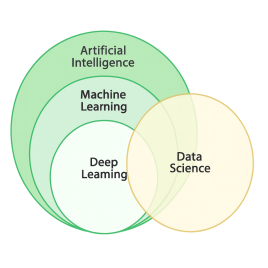
Figure 1 depicts the framework for the ML-based SRA of RC buildings. Some researchers are interested in application of machine learning methods for nonlinear modal analysis. Worden K, Green PL , maximum displacements of isolated pendulum system prediction, and seismic response prediction for obtaining fragility curves. Oh, et al. used 2700 synthetic records to create a neural network model that anticipates a building's seismic response based on record correlation. Using datasets of RC columns, Luo and Paal presented a new artificial approach for predicting the seismic response of RC frameworks. The seismic limit-state and seismic response capabilities of RC structures can be calculated using the ML-based prediction model. These results can then be utilized to estimate the initial IDR max as well as M-IDAs of both newly constructed” and existing buildings. The simulation outcomes are analyzed with a sample of the prediction outcomes from the technique ML model. An overview of the suggested strategy is presented in Figure 1.
Figure 1. Artificial Intelligence Working.
Most of the time, balanced dataset analysis is the intended use of ML methods. Strong and moderate earthquakes are rare occurrences, which cause imbalances in real-world datasets with majority and minority classes. To prevent the predictive ML models from favoring the majority class as well as disregarding the minority class, there should be an equal distribution of datasets for every class (Chelidze T, Kiria T, Melikadze G, Jimsheladze T, Kobzev G,) .
Many studies are conducted to assess a single building's seismic damage using the nonlinear finite element approach; however, because it requires more time and money, it is not to be applied to big-scale structures (Morfidis et al.) . Artificial intelligence (AI) approaches are being employed extensively in several engineering disciplines and have grown significantly in recent years. The construction industry is constantly seeking ways to improve efficiency, safety, and cost-effectiveness. Traditionally, assessing concrete strength, a critical factor in structural integrity, has relied on destructive testing methods. This research introduces Artificial Intelligence (AI) as a groundbreaking approach to overcome these limitations. AI refers to the field of computer science focused on building technology having cognitive ability that can mimic humans capabilities like learning, reasoning, and problem-solving. In this project, we create a model that forecasts concrete strength by utilizing machine learning, a branch of artificial intelligence. A sizable dataset with information on concrete mix designs and their corresponding compressive strengths is used to train this model. The AI can find patterns and learn to calculate the compressive strength of new concrete mixtures based only on their composition and age by examining these relationships. Monitoring in real time: Our model makes it possible to continuously monitor the development of concrete strength, in contrast to destructive testing, which only yields one data point. This enables prompt intervention and early detection of possible problems. Cost savings: Testing and sample preparation expenses are decreased when physical samples are no longer required. Preserved Materials: Concrete samples are not destroyed by the model, which can be important for large-scale projects. Data-Informed Risk Evaluation: Intelligent monitoring systems are made possible by the ability to predict strength in real-time. A more informed approach to risk assessment and maintenance planning is made possible by this constant flow of data. This research has the potential to revolutionize the construction industry by incorporating AI into the evaluation of concrete strength. This shift towards a data-driven approach may result in safer, more resilient, and sustainable building practices.
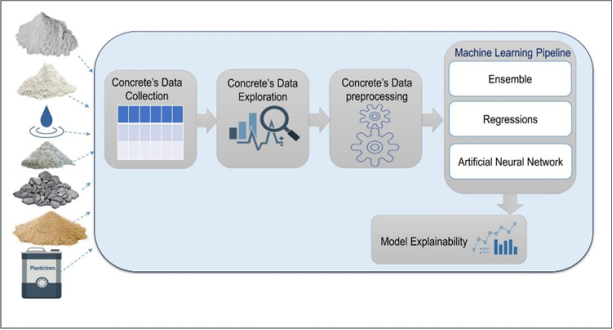
The foundation of this project is the application of an extensive dataset designed to forecast concrete's compressive strength, a crucial parameter affecting durability and structural integrity. This dataset contains a large number of concrete mixture parameters that have been carefully documented to aid in the creation and improvement of machine learning models that can predict concrete strength based on its composition and curing time. The dataset includes the age of the concrete at the time of testing as well as a number of features that represent the ingredients of a concrete mix. The primary metric for evaluating the concrete's ability to sustain loads is its compressive strength (csMPa), which is measured in megapascals (MPa). This is the parameter of interest in this dataset. The concrete's compressive strength, which is the prediction's target variable. This measure is essential for assessing the concrete's load-bearing capacity and is a major factor in determining whether it is suitable for a variety of construction applications. To find patterns, correlations, and the effects of various factors on concrete strength, the gathered data is statistically analyzed. Predictive model development is based on this analysis. Because it offers a dynamic tool for evaluating the integrity and health of concrete structures over timeloads, this predictive capability is crucial for real-time monitoring of these structures. Each component's amount, the concrete's age, and its measured compressive strength are all carefully recorded. The dataset used to train and test machine learning models is made up of this documentation. Records of real construction projects can be another important source of information. In addition to test results of sample cubes or cylinders made from the same concrete and tested at different ages, these records may contain information about concrete mix designs used in various project components. The process for prediction as given in Figure 2.
Figure 2. Machine Learning Flow for Concrete Prediction.
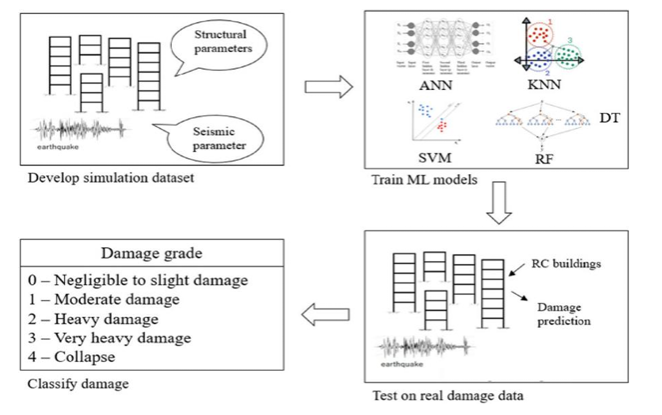
Most of the time, balanced dataset analysis is the intended use of ML methods. Strong and moderate earthquakes are rare occurrences, which cause imbalances in real-world datasets with majority and minority classes. To prevent the predictive ML models from favoring the majority class as well as disregarding the minority class, there should be an equal distribution of datasets for every class (Chelidze T, Kiria T, Melikadze G, Jimsheladze T, Kobzev G,) . Many studies are conducted to assess a single building's seismic damage using the nonlinear finite element approach; however, because it requires more time and money, it is not to be applied to big-scale structures (Morfidis et al.,) . Artificial intelligence (AI) approaches are being employed extensively in several engineering disciplines and have grown significantly in recent years. An ML-based rapid SRA approach was suggested by Tang et al. in an effort to lower the computational expense of estimating the likelihood that a building will be destroyed by an earthquake during its planned life. Investigations were conducted into the predictive power of several ML techniques, involving artificial neural networks (ANN), regression trees, random forests, support vector machines, as well as classification algorithms. The utilization of Artificial neural networks by (Morfidis et al.,) to produce an ideal prediction for the deterioration status of reinforced concrete buildings. Hwang et al. implemented machine learning-based techniques, involving both classification-based and regression-based algorithms, for the precise evaluation of the structural collapse classification and seismic response of RC buildings during upcoming earthquakes, accounting for modeling uncertainties at the component and system levels. CART (Classification and regression tree) and Random Forest techniques were employed by Zhang et al. to probabilistically determine the structural safety condition of a building damaged by an earthquake. Building vulnerability to aftershock collapse was assessed by Burton et al. utilizing ML-based techniques based on seismic response, mainshock intensity, as well as specific damage indicators. Harirchian et al. underscored the importance of employing a straightforward, trustworthy, and precise procedure for evaluating structures to determine potential earthquake risks and consequent casualties, thereby facilitating emergency preparedness. A number of writers recommended that further studies should focus on enhancing the SVM classifier's performance by incorporating more data, assessing the influence of each feature, and employing the soft margin technique for multi-class classification as given in Figure 3.
Figure 3. Seismic Damage Prediction of RC Building Using Machine Learning.
The properties of the structural system as well as the ground motion features—which are composed of” numerous parameters—are linked to building damage. It might be challenging to determine which structural or seismic characteristics are most likely to cause damage and how much of an impact they have on structural performance. The possibilities and difficulties of using machine learning (ML) in earthquake engineering were investigated by Xie et al. . Because machine learning can handle complicated issues, provide computing efficiency, propagate and treat uncertainty, and ease decision-making, it has a lot of potential. The authors acknowledged the difficulty in acquiring high-quality data points in particular situations, such as brittle shear failures in RC columns, but they also highlighted the need for more transparent, easily accessible, and high-quality data in a format that can be read by computers. Multiple machine learning techniques were taken into consideration for the purpose of estimating the compressive strength of concrete, each with its strengths and weaknesses: Linear Regression: A baseline model because of its basic nature and interpretability. It assumes a linear relationship between the independent variables and the dependent variable. Decision Trees: A non-linear model that uses a tree-like model of decisions and their possible consequences. It’s easy to interpret but can be prone to overfitting. Random Forest: An ensemble technique that builds various decision trees while learning and outputting the mean prediction of the individual trees. It reduces the risk of overfitting and improves predictive accuracy.
3. Results and Discussions
Using machine learning (ML) models to forecast the compressive strength of concrete is a major breakthrough in leveraging data analytics within the construction industry. This section examines output gathered through the use of multiple machine learning models, with a particular emphasis on the Random Forest Regressor's performance, which turned out to be the most successful. Key findings, their implications for the construction industry, and ideas for further study and application are highlighted in the discussions. A number of machine learning (ML) models, such as Random Forest Regressor, Decision Trees, and Linear Regression, were used in the attempt to precisely forecast the compressive strength of concrete. Due to the intricacy of the data it processes and the inherent methodologies of each model, each table has unique benefits and limitations. Because of its linear assumption, linear regression provides a straightforward, understandable model but lacks the complexity required to precisely forecast concrete strength. Although decision trees are better at managing non-linear relationships, their reliability for broad predictions is impacted by their propensity for overfitting. The Random Forest Regressor turns out to be the best option because it balances the capacity to model intricate relationships with enhanced generalizability and accuracy, albeit at the expense of higher computational demand and less interpretability.
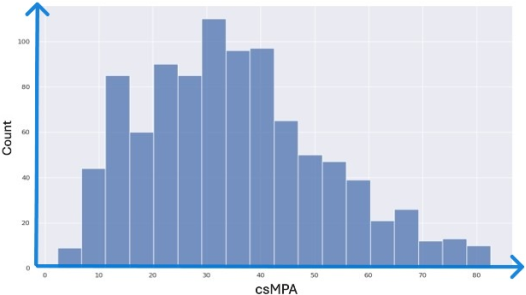
The dataset's distribution of concrete strength shown in Figure 4 indicates a predominant concentration of data points ranging between 30 csMPa to 50 csMPa. This interval emerges as the most common range for concrete compressive strength. Understanding this distribution is crucial, as it offers insightful information on the typical strength levels observed within the dataset. However, it's essential to note that concrete strength can vary significantly based on multiple factors, and analyzing a great variety of strengths is important for a extensive understanding of the material's behavior and properties.
Figure 4. Distribution of Concrete Strength Within the Dataset.
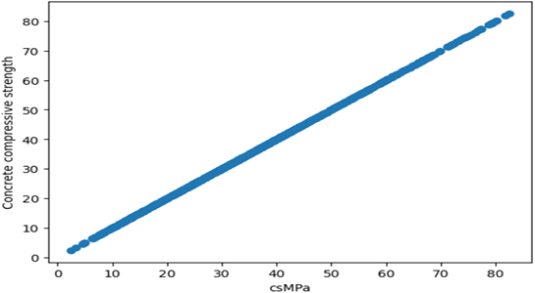
In this context, csMPa refers to the actual measured compressive strength of concrete samples, while "Concrete compressive strength" is understood to be the predicted strength values derived by machine learning model. Plotting predicted strength against actual strength allows for a visual analysis of the model's accuracy and reliability. Fig 5 shows the predicted compressive strength vs. actual compressive strength where X-Axis (Actual csMPa) represents the actual measured compressive strength of the concrete samples, obtained through standard testing procedures & Y-Axis (Predicted Strength) shows the strength values predicted by the machine machine learning algorithm utilizing the concrete mix's input parameters.
Figure 5. Predicted Compressive Strength vs. Actual Compressive Strength.

The successful application of machine learning to predict concrete compressive strength marks a notable milestone in the intersection of construction engineering and data analytics. Moving forward, embracing these technologies, and continuously refining the models and their application will be pivotal in advancing the construction industry towards a more data-driven and efficient future. By carefully gathering and examining data about the concrete mixture, including variables like cement, slag, fly ash, water, superplasticizer, aggregates and curing age, we developed and compared several machine learning models: Linear Regression, Decision Trees, and Random Forest Regressors. The Random Forest Regressor emerged as the standout model as details shown in Table 1, demonstrating superior predictive accuracy with the lowest Root Mean Square Error (RMSE) of 5.35. This achievement underscores the model's effectiveness in capturing the complex, non-linear interactions between the concrete mix components and their impact on compressive strength. RMSE for Random Forest Regressor is 5.35, indicating the model's high degree of accuracy in determining concrete compressive strength across diverse mix designs and curing ages. R² score is close to 0.9, reflecting that the Random Forest model could explain approximately 90% of the variance in compressive strength, highlighting its effectiveness in capturing the complex dynamics of concrete strength development. The Random Forest Regressor, with its superior accuracy and robustness, demonstrates the potential of ML to revolutionize traditional practices, offering pathways to optimized construction processes, enhanced structural integrity, and increased sustainability.
Table 1. Machine Learning Model Performance.

Model Name

Mean Squared Error (MSE)

Mean Absolute Error (MAE)

Coefficient of Determination

Linear Regression Model

74.33

6.75

0.72

Random Forest Regression

26.23

3.59

0.90

Decision Tree Regression

57.27

4.78

0.78

Support Vector Regression

82.27

7.12

0.69

These studies demonstrate that while training machine learning models to evaluate the reaction of structural systems, either ground motion or structural factors are taken into consideration, it's possible that none of the underlying complexity will be fully revealed by the current ML techniques. This would limit the applicability of ML models. Considering both seismic and structural features improves the adaptability of machine learning models when predicting damage to structures during an earthquake. According to the study, the ability to perform accurate SRA of reinforced concrete in buildings using machine learning frameworks is crucial for risk management and mitigation. Assessing building damage following an earthquake is a crucial first step in disaster response and recovery planning for stakeholders and decision-makers. The extent of the damage to the buildings can vary from minor to severe enough to result in their collapse, depending on the characteristics of the building, the state of the soil, the characteristics of earthquakes and ground motion, and other factors. Because of advancements in machine learning and data availability, a vast amount of research has been done on the topic of earthquake engineering. Kazemi et al. generated the seismic fragility curve for reinforced concrete buildings using machine learning (ML) algorithms in Python software, which used less computing power than traditional techniques. They employed hyperparameter optimization and Incremental Dynamic Analyses on 165 RC frames to prepare the training dataset and found that ANNs, ETR, ERTR, BR, XGBoost, and HGBR demonstrated high accuracy. Additionally, the writers presented a GUI tool for assessing the seismic risk of RC buildings. The proposed ML-based prediction model was validated with case studies and demonstrated to be a trustworthy instrument for evaluating RCC buildings' seismic risk and vulnerability. Kourehpaz & Hutt introduced a framework which used the laws of machine learning for seismic risk assessment, which can predict a building’s state of damage post-earthquake using ground motion intensity measures and structural attributes. The authors tested six machine learning algorithms, including Logistic Regression, K- Nearest Neighbors, Decision Tree, Random Forest, AdaBoost, and Gradient Boosting, and trained them using a dataset of nonlinear response history analysis results from 36 reinforced concrete shear wall building structural models. The findings suggest that the Gradient Boosting technique is the most efficient algorithm, achieving an F1 score of 87%. The proposed framework was also retrained to identify collapse instances, utilizing synthetic data samples, which increased the percentage of observed collapse cases correctly classified from 76% to 93%. The study underlines the potential of using nonlinear analysis results from risk-based seismic performance assessments to develop machine learning predictive models to improve regional seismic risk assessments. However, the authors noted that the proposed framework is applied to modern flexure dominated RC shear wall buildings, and future studies should extend the approach to buildings with different structural systems and from different construction eras.
4. Conclusions
This project embarked on the ambitious task of harnessing machine learning to determine concrete’s compressive strength, a fundamental property critical to the construction industry's ability to ensure the structural integrity and longevity of buildings and infrastructure. Moving forward, continuous refinement of the model, expansion of the dataset, and further integration of technology into construction workflows will be key to unlocking even greater advancements and achieving a more data-driven, sustainable future in construction. A plot comparing predicted concrete compressive strength against actual measurements is a powerful tool for assessing the effectiveness of machine learning models in predicting concrete strength. It visually encapsulates the accuracy of predictions and can unearth systematic issues or validate the model's effectiveness, guiding further refinement and application in real-world scenarios. With the goal of increasing accuracy and dependability in construction material optimization and quality control initiatives, this analytical method aids in the ongoing development of predictive models. Recent research indicates that intricate modeling and analysis are required to determine the seismic reactions and seismic performance levels of reinforced concrete structures. Most of these analyses are time-consuming and require the use of fast computer systems. The unpredictable nature of seismic events is another factor affecting the achievement of seismic performance. The particulars of the building and the assessment task determine which seismic risk evaluation technique is best. PVA offers a more thorough evaluation than RVS, but RVS offers a more economical way to quickly assess many buildings. DVA is thought to be the most thorough and accurate technique for assessing seismic risk. Although ML-based techniques are effective and fairly accurate, they have drawbacks of their own. The benefits of machine learning in SRA of RC in buildings address the problem of class unbalance and emphasize the critical role of feature selection in enhancing model results. It is imperative to comprehend the advantages and disadvantages of each methodology.
This project's thorough risk analysis was crucial in spotting possible dangers and putting preventative measures in place. As a result, the concrete compressive strength prediction model not only demonstrated high accuracy but also dependability and real-world application in the construction sector. In order to handle any new risks and guarantee that the model continues to be a useful resource for construction experts, ongoing observation and modification will be necessary going forward.
Abbreviations

RCC

Reinforced Cement Concrete

RC

Reinforced Concrete

SRA

Seismic Risk Assessments

SHM

Structural Health Monitoring

NDT

Non Destructive Testing

AI

Artificial Intelligence

RMSE

Root Mean Square Error

RVS

Rapid Visual Screening

PVA

Preliminary Vulnerability Assessment

DSA

Detailed Seismic Assessment

ML

Machine Learning

SVM

Support Vector Machines

API

Application Programming Interface

M-IDA

Modal Incremental Dynamic Analysis

IDR

Interstory Drift Ratio

MPa

Megapascals

ANN

Artificial Neural Networks

CART

Classification and Regression Tree

DVA

Dynamic Vibration Absorber

Conflicts of Interest
The authors declare no conflicts of interest.
References
[1] Ferreira, T. M., R. Maio, and R. Vicente (2017). Analysis of the impact of large-scale seismic retrofitting strategies through the application of a vulnerability-based approach on traditional masonry buildings. Earthquake Engineering and Engineering Vibration, 16(2), 329–48.
[2] Kindahunsi, A. A., Uzoegbo (2015). H. C. Strength and Durability Properties of concrete with starch Admixture. J. Concr. Mater., 9, 323–335.
[3] Kim, H. S.; Lee, S. H., Moon (2007), H. Y. Strength properties and durability aspects of high strength concrete using Korean metakaolin. Constr. Build. Mater., 21, 1229-1237.
[4] Behnood, A. & Golafshani (2022), E. M. Artificial intelligence to model the performance of concrete mixtures and elements: A review. Arch. Comput. Methods Eng.
[5] Ben Chaabene, W., Flah, M. & Nehdi (2020), M. L. Machine learning prediction of mechanical properties of concrete: Critical review. Constr. Build. Mater.
[6] Nguyen, H., Vu, T., Vo, T. P. & Thai (2021), H. T. Efficient machine learning models for prediction of concrete strengths. Constr. Build. Mater.
[7] Kausay T, Simon T (2005), Acceptance of Concrete Compressive Strength. 1-19.
[8] Megid, W. A., Chainey, M. A., Lebrun, P., Hay (2019), D. R. Monitoring fatigue cracks on eye bars of steel bridges using acoustic emission: A case study. Eng. Fract. Mech., 211, 198-208.
[9] Zhang, T.; Mahdi, M.; Issa, M.; Xu, C.; Ozevin, D. (2023), Experimental study on monitoring damage progression of basalt-FRP reinforced concrete slabs using acoustic emission and machine learning. Sensors, 23, 8356.
[10] Bado, M. F.; Casas, J. R.; Kaklauskas, G.(2021), Distributed Sensing (DOFS) in reinforced concrete members for reinforcement strain monitoring, crack detection and bond-slip calculation. Eng. Struct., 226, 111385.
[11] Fernandez, I.; Berrocal, C. G.; Almfeldt, S.; Rempling, R. Monitoring of new and existing stainless-steel reinforced concrete structures by clad distributed optical fibre sensing.
[12] Eslamlou, A. D.; Ghaderiaram, A.; Schlangen, E.; Fotouhi, M.(2023), A review on non-destructive evaluation of construction materials and structures using magnetic sensors. Constr. Build. Mater., 397, 132460.
[13] Chen, H.; Zhou, M.; Gan, S.; Nie, X.; Xu, B.; Mo, Y. L.(2021), Review of wave method-based non-destructive testing for steel-concrete composite structures: Multiscale simulation and multi-physics coupling analysis. Constr. Build. Mater., 302, 123832.
[14] Gavarini, C.(2021), Seismic risk in historical centers. Soil Dyn. Earthq. Eng., 21, 459-466.
[15] FEMA 249. (1994). Assessment of the State-of-the-Art Earthquake Loss Estimation Methodologies.
[16] Meirovitch, L. (1967). Analytical Methods in Vibrations, Macmillan, New York.
[17] Yao, J. T. P. (1985). Safety and Reliability of Existing Structures, Pitman, Boston, 130 pp.
[18] Joslyn, C. and Booker, J. (2005). Generalized Information Theory for Engineering Modeling and Simulation, Engineering Design Reliability Handbook, ed. E Nikolaidis et al., pp. 9: 1-40, CRC press.
[19] Hwang SH, Mangalathu S, Shin J, Jeon JS.(2021), Machine learning-based approaches for seismic demand and collapse of ductile reinforced concrete building frames. J Build Eng., 34.
[20] Lu X, Plevris V, Tsiatas G, De Domenico D.(2022), Artificial intelligence-powered methodologies and applications in earthquake and structural engineering. Front Built Environ., 43.
[21] Xie Y, Ebad Sichani M, Padgett JE, DesRoches R.(2020), The promise of implementing machine learning in earthquake engineering: a state-of-the-art review. Earthquake Spectra., 36(4), 1769-1801.
[22] Harirchian E, Hosseini SE, Jadhav K,(2021), A review on application of soft computing techniques for the rapid visual safety evaluation and damage classification of existing buildings. J Build Eng., 43.
[23] Harirchian, E.(2015). Constructability Comparison Between IBS and Conventional Construction. Ph.D. Thesis, University Technology Malaysia, Skudai, Malaysia, 20.
[24] Worden K, Green PL.(2017), A machine learning approach to nonlinear modal analysis. Mech Syst Signal Process, 84, 34-53.
[25] Oh BK, Glisic B, Park SW, Park HS.(2020), Neural network-based seismic response prediction model for building structures using artificial earthquakes. J Sound Vib., 468.
[26] Luo H, Paal SG.(2022), Artificial intelligence-enhanced seismic response prediction of reinforced concrete frames. Adv Eng Inform., 52.
[27] Chelidze T, Kiria T, Melikadze G, Jimsheladze T, Kobzev G.(2022), Earthquake forecast as a machine learning problem for imbalanced datasets: example of Georgia, Caucasus. Front Earth Sci., 10.
[28] Morfidis K, Kostinakis K.(2017), Seismic parameters’ combinations for the optimum prediction of the damage 14 state of R/C buildings using neural networks. Adv Eng Software., 10.
[29] Tang Q, Dang J, Cui Y, Wang X, Jia J.(2021), Machine learning-based fast seismic risk assessment of building structures. J Earthquake Eng., 1-22.
[30] Zhang Y, Burton HV, Sun H, Shokrabadi M.(2018), A machine learning framework for assessing post-earthquake structural safety. Struct Saf., 72, 1-16.
[31] Burton HV, Sreekumar S, Sharma M, Sun H.(2017), Estimating aftershock collapse vulnerability using mainshock intensity, structural response, and physical damage indicators. Struct Saf., 68.
[32] Kazemi F, Mohebi B, Jankowski R.(2021), Predicting the seismic collapse capacity of adjacent SMRFs retrofitted with fluid viscous dampers in pounding condition. Mech Syst Signal Process., 161.
[33] Kourehpaz, P., & Hutt, C. M. (2022), Machine Learning for Enhanced Seismic Damage Assessment of Buildings,
Cite This Article
  • APA Style

    Padelkar, S., Narwade, R., Nagarajan, K., Narwade, R. (2025). Real Time Strength Monitoring of Concrete and Risk Assessment of Building Structures Using Machine Learning. American Journal of Civil Engineering, 13(6), 362-372. https://doi.org/10.11648/j.ajce.20251306.14

    Copy | Download

    ACS Style

    Padelkar, S.; Narwade, R.; Nagarajan, K.; Narwade, R. Real Time Strength Monitoring of Concrete and Risk Assessment of Building Structures Using Machine Learning. Am. J. Civ. Eng. 2025, 13(6), 362-372. doi: 10.11648/j.ajce.20251306.14

    Copy | Download

    AMA Style

    Padelkar S, Narwade R, Nagarajan K, Narwade R. Real Time Strength Monitoring of Concrete and Risk Assessment of Building Structures Using Machine Learning. Am J Civ Eng. 2025;13(6):362-372. doi: 10.11648/j.ajce.20251306.14

    Copy | Download

  • @article{10.11648/j.ajce.20251306.14,
      author = {Shreyanshu Padelkar and Raju Narwade and Karthik Nagarajan and Rajashri Narwade},
      title = {Real Time Strength Monitoring of Concrete and Risk Assessment of Building Structures Using Machine Learning},
      journal = {American Journal of Civil Engineering},
      volume = {13},
      number = {6},
      pages = {362-372},
      doi = {10.11648/j.ajce.20251306.14},
      url = {https://doi.org/10.11648/j.ajce.20251306.14},
      eprint = {https://article.sciencepublishinggroup.com/pdf/10.11648.j.ajce.20251306.14},
      abstract = {This study proposes a novel approach for real-time strength monitoring and risk assessment of building structures by leveraging machine learning for concrete compressive strength prediction. The assessment of the prevailing Reinforced Concrete (RC) buildings for a seismic damage is a hard structural engineering trouble and a key problem for disaster mitigation and resilience. The seismic damage evaluation of those structures aids in figuring out whether or not the buildings can be used effectively after the earthquake by knowing the chance of damage degrees. We developed a machine learning model capable of analyzing various concrete mix parameters, including the amount of cement, slag, fly ash, water, superplasticizer, coarse aggregate, fine aggregate, and the age of the concrete. The model predicts the compressive strength, a crucial indicator of a RCC column's structural integrity. In structural engineering, assessing the seismic susceptibility of the existing reinforced concrete (RC) buildings is a critical task that is essential to resilience and catastrophe preparedness. Seismic Risk Assessments (SRA) of these structures help determine whether a building is safe for post-earthquake use by tracking the likelihood of damage. approach allows for continuous assessment of a building's structural health, enabling proactive identification of potential risks. The inclusion of this technology into current monitoring systems offers building managers and engineers actionable insights which help them make informed decisions about maintenance and repair requirements. This research establishes new methods for proactive and effective building structure risk assessment which improves safety and extends the life span of constructed environments.},
     year = {2025}
    }
    

    Copy | Download

  • TY  - JOUR
    T1  - Real Time Strength Monitoring of Concrete and Risk Assessment of Building Structures Using Machine Learning
    AU  - Shreyanshu Padelkar
    AU  - Raju Narwade
    AU  - Karthik Nagarajan
    AU  - Rajashri Narwade
    Y1  - 2025/12/20
    PY  - 2025
    N1  - https://doi.org/10.11648/j.ajce.20251306.14
    DO  - 10.11648/j.ajce.20251306.14
    T2  - American Journal of Civil Engineering
    JF  - American Journal of Civil Engineering
    JO  - American Journal of Civil Engineering
    SP  - 362
    EP  - 372
    PB  - Science Publishing Group
    SN  - 2330-8737
    UR  - https://doi.org/10.11648/j.ajce.20251306.14
    AB  - This study proposes a novel approach for real-time strength monitoring and risk assessment of building structures by leveraging machine learning for concrete compressive strength prediction. The assessment of the prevailing Reinforced Concrete (RC) buildings for a seismic damage is a hard structural engineering trouble and a key problem for disaster mitigation and resilience. The seismic damage evaluation of those structures aids in figuring out whether or not the buildings can be used effectively after the earthquake by knowing the chance of damage degrees. We developed a machine learning model capable of analyzing various concrete mix parameters, including the amount of cement, slag, fly ash, water, superplasticizer, coarse aggregate, fine aggregate, and the age of the concrete. The model predicts the compressive strength, a crucial indicator of a RCC column's structural integrity. In structural engineering, assessing the seismic susceptibility of the existing reinforced concrete (RC) buildings is a critical task that is essential to resilience and catastrophe preparedness. Seismic Risk Assessments (SRA) of these structures help determine whether a building is safe for post-earthquake use by tracking the likelihood of damage. approach allows for continuous assessment of a building's structural health, enabling proactive identification of potential risks. The inclusion of this technology into current monitoring systems offers building managers and engineers actionable insights which help them make informed decisions about maintenance and repair requirements. This research establishes new methods for proactive and effective building structure risk assessment which improves safety and extends the life span of constructed environments.
    VL  - 13
    IS  - 6
    ER  - 

    Copy | Download

Author Information