Abstract
Tall steel buildings are increasingly governed by serviceability considerations arising from seismic and wind actions, where control of lateral deflection and inter-storey drift becomes as critical as strength-based design. This paper investigates the fundamental relationship between lateral stiffness and deflection response in tall steel structures, with the objective of clarifying the role of stiffness in satisfying codal requirements for safety, serviceability, and occupant comfort. A common misconception in design practice is that increased structural flexibility invariably leads to reduced seismic demand. While period elongation associated with reduced stiffness may lower seismic base shear, it can result in excessive lateral deflections, inter-storey drifts, and wind-induced accelerations that govern serviceability performance. Using a shear-building idealisation, closed-form analytical relationships are developed to link effective lateral stiffness, fundamental natural period, inter-storey drift, and seismic base shear. Three representative lateral load-resisting systems-a steel moment-resisting frame (SMRF), a braced frame (BRBF), and a core-outrigger system-are evaluated for a 20-storey steel building to illustrate the influence of stiffness on global and local response parameters. The comparative results demonstrate that increased stiffness leads to improved drift control and wind-serviceability performance, even where seismic base shear increases modestly. A worked example is presented to demonstrate drift verification against Eurocode seismic serviceability limits and wind habitability criteria, showing that serviceability requirements often govern system selection in tall buildings. The study provides practical guidance on balancing stiffness, damping, and structural configuration during preliminary design. The proposed analytical framework supports rational comparison of alternative lateral systems and offers useful insights for engineers prior to undertaking detailed numerical analysis.
Keywords
Tall Steel Buildings, Stiffness-deflection Relationship, Seismic Design, Wind Serviceability, Drift Control, Outrigger Systems
1. Introduction
The design of tall steel buildings requires a careful balance between strength, stiffness and serviceability. While seismic and wind loads primarily govern lateral load design, occupant comfort criteria, often control the selection of the structural system. A recurring misconception in practice is that allowing greater flexibility always reduces seismic and wind effects. This is only partly true. Although period elongation may reduce seismic base shear, excessive flexibility leads to unacceptable inter-storey drifts and wind-induced accelerations.
This paper clarifies the mathematical basis of the stiffness-deflection relationship, compares alternative lateral systems, and provides practical guidelines for safe and economical tall building design using simple, computational-friendly methods without relying on commercial software and as such the aim of the study gets satisfied. The study is supported by two key graphical correlations-Deflection vs Stiffness (
Figure 2) and Base Shear vs Fundamental Period (
Figure 3).
Recent studies have highlighted the influence of soil-structure interaction (SSI) on the dynamic response of tall buildings. Kilicer and Ozgan
| [5] | Kilicer, S., Ozgan, K. and Daloglu, A. (2018) Effects of soil-structure interaction on behavior of reinforcedconcrete structures. Journal of Structural Engineering and Applied Mechanics, 1(1), 28-33. |
| [6] | Kilicer, S. and Ozgan, K. (2016) Investigation of soil-structure interaction for design of reinforced concretestructures under earthquake load. |
[5, 6]
and Ozgan et al.
| [4] | Ozgan, K., Kilicer, S. and Daloglu, A. (2022) Soil-structure interaction effect on resistance of steel frame againstprogressive collapse. Journal of Performance of Constructed Facilities. |
[4]
showed that SSI generally increases flexibility, lengthens fundamental periods and modifies seismic demand. Yang et al.
further demonstrated that SSI effects become more pronounced under long-period ground motions. In contrast, modern stiffening strategies such as outrigger systems have been examined by Angelucci et al.
, who reported substantial reductions in drift for high-rise structures. Performance-based wind design reviews emphasise the need to limit accelerations and habitability criteria in addition to static wind checks
| [1] | Abdelwahab, M., et al. (2023) Performance-based wind design for tall buildings: review and state of the art. Structures. |
[1]
. The present study considers a fixed-base structure on stiff ground, where SSI effects are minimal; however, in softer soils the effective stiffness would reduce and periods would lengthen accordingly.
Many previous studies and some of the studies cited here primarily employ detailed numerical approaches, such as finite-element modelling, soil-structure interaction analysis, or performance-based wind and seismic assessment, surrogate modeling (Deep Neural Networks), and optimization algorithms (NSGA-II) to achieve multi-objective design (cost vs. performance) and predict inelastic behavior, to evaluate the response of tall buildings. These methods provide high-fidelity results but are often computationally intensive and best suited for advanced stages of design. In contrast, the present study develops a simplified and compact analytical framework that links effective lateral stiffness, global drift, and fundamental period through closed-form relations. This enables rapid comparison of alternative lateral systems and provides practical design insight at the preliminary stage without dependence on commercial software, while remaining consistent with code-based serviceability requirements. The objective is not to replace numerical analysis, but to provide a transparent and rapid means of comparing alternative lateral systems and assessing serviceability behaviour using parameters readily available to practicing engineers.
2. Theoretical Framework
2.1. Shear Building Model
The inter-storey drift at level i is expressed as:
The roof displacement is obtained as:
2.2. Period-stiffness Relation
The fundamental period of vibration is approximated as:
2.3. Seismic Base Shear
Eurocode design base shear:
V_b = (S_a / gR) × I × W(4)
2.4. Wind Forces
The equivalent static wind force on the building is:
Wind load does not depend upon stiffness, but resulting accelerations and drifts do depend strongly upon the stiffness and damping.
The analytical relations employed herein assume a first-mode-dominated response, which is typical of regular tall buildings. Higher-mode effects, while relevant for irregular or extremely slender structures, are not explicitly modelled in order to maintain clarity in the stiffness-drift formulation.
Accordingly, the proposed relations are intended for conceptual understanding and preliminary system selection, and should be complemented by detailed numerical analysis at later design stages.
3. Comparative Analysis and Eurocode Drift Check
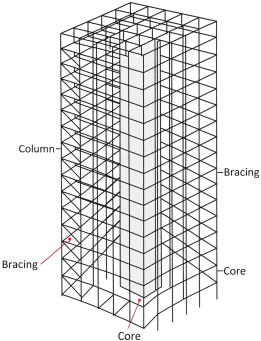
A representative 20-storey steel building, height 60 m (
Figure 1), seismic weight W = 1.08 × 10⁵ kN is analysed.
Figure 1. Isometric Conceptual Sketch - 20-Storey Steel Building.
Assumptions:
Storeys n = 20, storey height = 3 m → H = 60 m.
Floor plate = 30 m × 30 m = 900 m².
Gravity load = 6.0 kN/m² → W_f = 5400 kN/floor.
Total seismic weight W = 20 × 5400 = 1.08×10⁵ kN.
Mass M = W / g.
Three lateral systems are compared:
(A) SMRF, (B) BRBF, (C) Outrigger-Core.
Table 1 summarises stiffness, period, base shear and drift.
Table 1. Comparison of Effective Stiffness, Period, Base Shear and Drift.
System | Keff (kN/m) | T (s) | Vb (kN) | Δ_roof (m) | Drift (%) |
A: Moment Frame (SMRF) | 2.0×10⁵ | 1.55 | 38,400 | 0.192 | 0.32 |
B: Braced Frame (BRBF) | 4.0×10⁵ | 1.10 | 60,000 | 0.150 | 0.25 |
C: Outrigger + Core | 8.0×10⁵ | 0.78 | 60,000 | 0.075 | 0.125 |
WORKED EXAMPLE - EUROCODE DRIFT CHECK FOR SMRF (20-Storey)
Step 1 - Input Parameters
K_eff (SMRF) = 2.0×10⁵ kN/m
R = 4.0 (Eurocode, DCM steel frame)
S_a = 1.0 g (illustrative)
I = 1.0
Step 2 - Compute Base Shear
V_b = (S_a / gR) × I × W
= (1.0 / (9.81×4)) × 1.08×10⁵
≈ 38,400 kN
Step 3 - Roof Displacement
Δ_roof = V_b / K_eff
= 38,400 / (2.0×10⁵) = 0.192 m
Step 4 - Drift Ratio
Δ/H = 0.192 / 60 = 0.0032 = 0.32%
Step 5 - Eurocode Check
Limit = 0.40% → OK.
Step 6 - Wind Serviceability
H/500 = 120 mm, H/1000 = 60 mm.
SMRF drift = 192 mm → exceeds both limits.
Conclusion:
Wind drift governs; SMRF is too flexible without bracing or outriggers.
It should be noted that
Table 1 reports global roof drift ratios (Δ/H), whereas
Figure 5 presents the maximum inter-storey drift ratio; the two measures are complementary and are used to assess overall serviceability and local deformation demand, respectively.
Table 2 specifies the code based drift values used in the study.
Table 2. Code-Based Drift Limits Used in the Study.
Loading case | Code reference | Drift limit (h/n) | Approx. limit (%) |
Seismic (serviceability) | IS 1893 | [9] | BIS: IS1893 (Part 1): 2016: Criteria for Earth Quake Resistant Design. |
[9] / Eurocode 8| [8] | British Standards Institution (2004) Eurocode 8: Design of structures for earthquake resistance - Part 1: Generalrules, seismic actions and rules for buildings. BS EN 1998-1: 2004. London: BSI. |
[8] | 0.004h | 0.40 , 8] |
Wind (habitability) | IS 875 | [10] | BIS: IS875 (Part 3): 2015: Wind Loads on Buildings and Structures. |
[10] / Eurocode 1| [7] | British Standards Institution (2005) Eurocode 1: Actions on structures - Part 1-4: General actions - Wind actions. BS EN 1991-1-4: 2005. London: BSI. |
[7] | 0.0025h | 0.25 , 7] |
Table 3 contains geometric, loads & spectrum related parameters.
Table 3. Design Parameters Used for the 20-Storey Baseline Model.
Parameter | Value |
Number of storeys | 20 |
Storey height | 3 m |
Total height H | 60 m |
Plan area | 30 m × 30 m |
Gravity load | 6.0 kN/m² |
Seismic weight W | 1.08×10⁵ kN |
Damping ratio ξ | 5% |
Spectrum type | Eurocode 8 - Type 1 | [8] | British Standards Institution (2004) Eurocode 8: Design of structures for earthquake resistance - Part 1: Generalrules, seismic actions and rules for buildings. BS EN 1998-1: 2004. London: BSI. |
[8] |
Soil class | B (assumed) |
Importance factor I | 1.0 |
Response reduction factors R | SMRF = 4.0, BRBF = 3.0, Outrigger = 3.0 |
4. Discussion
The comparative analysis highlights the fundamental trade‑off between seismic force reduction and drift control in tall steel buildings:
1) SMRF: Most flexible system-lowest seismic base shear due to period elongation, but highest drift and poorest wind performance.
2) BRBF: Provides higher stiffness-moderate increase in base shear but significantly improved drift behaviour.
3) Outrigger-Core System: Highest stiffness-lowest drift, better control of wind accelerations, and superior serviceability performance.
4) The BRBF and outrigger-core systems, despite having different fundamental periods, show identical base-shear values in
Table 1 because both periods lie within the constant spectral-acceleration plateau of the adopted design spectrum, resulting in the same spectral acceleration S_a and hence the same base shear V_b.
Wind forces for a given height and geometry remain similar across systems, but wind-induced accelerations and serviceability drifts differ substantially. Flexible systems experience amplified perceptible motions, often exceeding habitability criteria. Thus, codes impose dual control: minimum seismic shear and maximum allowable drift. The analysis shows that serviceability limits, particularly from wind, typically govern tall steel building design rather than ultimate seismic demands.
5. Practical Guidelines
1) Drift limits (~0.004h seismic, H/500-H/1000 wind) govern tall steel building design.
2) Outrigger or braced systems are recommended for reliable drift control.
3) Supplemental damping (viscous, viscoelastic, tuned mass dampers) effectively reduces wind accelerations without excessive steel tonnage.
4) Designers should balance stiffness, damping, and structural economy rather than relying solely on period elongation to reduce seismic forces.
5) Excessive flexibility undermines both comfort and façade integrity and as such designs must target acceptable accelerations.
6. Curves and Graphic Representation of Drift Values for the Case Study
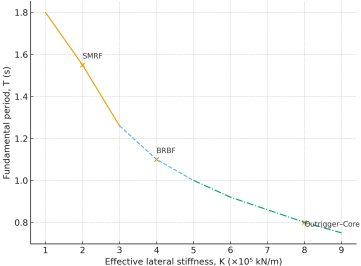
Figure 2. Period vs Effective Stiffness.
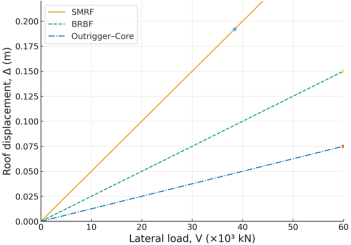
Figure 2 illustrates the correlation between the effective lateral stiffness (K) and the fundamental period (T), following the idealised stiffness-period relationship. Increasing stiffness shortens the natural period, increasing seismic base shear but reducing lateral drift. This curve forms a core theoretical basis for the study.
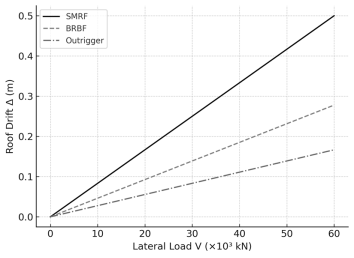
Figure 3. Roof Displacement vs Lateral Load.
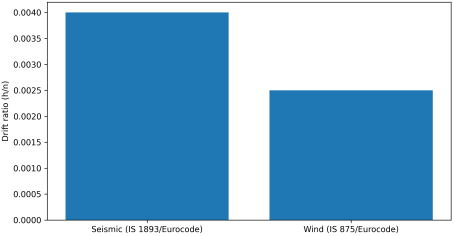
Figure 3 presents the computed roof displacements and inter-storey drift profiles for the three systems. The SMRF shows the largest drifts due to its flexibility, while the outrigger-core system displays the smallest drifts, confirming the influence of stiffness on performance under lateral actions.
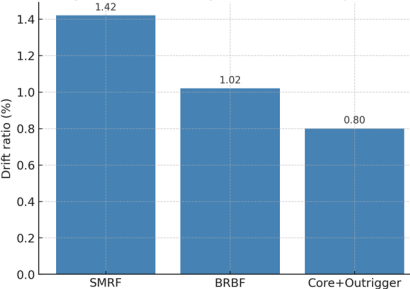
Figure 5. Maximum Inter-Storey Drift Ratio Under Seismic Serviceability Loading for the Three Lateral Systems, Compared Against the 0.004H Serviceability Drift Limit.
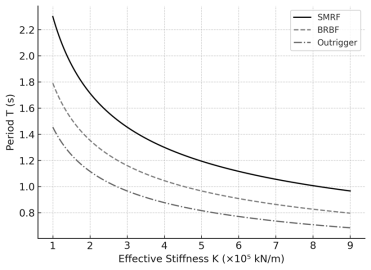
Figure 5: The figure is intended for comparative assessment of drift control efficiency and illustrates the progressive reduction in peak inter-storey drift with increasing system stiffness (SMRF → BRBF → Core-Outrigger), referenced against the 0.004H seismic serviceability drift limit.
It may be noted that
Figure 5 is intended solely for comparative assessment of drift control efficiency and is not meant to numerically replicate the global drift ratios in the tables.
7. Parametric Extension to 30- and 40-storey Buildings
To demonstrate that the stiffness-deflection behaviour observed for the 20-storey prototype is not incidental, a scaled parametric extension was performed for 30- and 40-storey buildings. The plan size is maintained at 30 m × 30 m, with storey height fixed at 3 m. Seismic weight is scaled linearly with the number of floors.
Effective stiffness ratios for the three systems (SMRF: BRBF: Outrigger = 1.0: 1.8: 3.0) are retained. Global stiffness reduces with height following:
K = K₂₀ (20/n)²
Periods follow a height-dependent law calibrated to the 20-storey baseline (T ≈ 1.5 s for SMRF). Base shear follows the relation V_b ∝ W / T. Roof drift is computed using Δ = V_b / K_eff.
Parametric Results Summary:
20 Storeys:
SMRF - T = 1.50 s, Drift = 192 mm (0.32%)
BRBF - T = 1.12 s, Drift = 143 mm (0.24%)
Outrigger - T = 0.87 s, Drift = 111 mm (0.18%)
30 Storeys:
SMRF - T = 2.03 s, Drift = 478 mm (0.53%)
BRBF - T = 1.52 s, Drift = 356 mm (0.40%)
Outrigger - T = 1.17 s, Drift = 276 mm (0.31%)
40 Storeys:
SMRF - T = 2.52 s, Drift = 913 mm (0.76%)
BRBF - T = 1.88 s, Drift = 681 mm (0.57%)
Outrigger - T = 1.46 s, Drift = 527 mm (0.44%)
The stiffness scaling relation adopted for the parametric extension, expressed as K = K_20 (20/n)², together with the associated period scaling, should be regarded as a heuristic representation of how global stiffness reduces and periods increase with height. These expressions are intended to preserve the observed stiffness-deflection trends across different building heights and to provide a rational comparative framework, rather than to serve as detailed design calibrations.
Table 4. Parametric variation of period, base shear and drift.
Height (storeys) | System | Period T (s) | Base shear Vb (×10³ kN) | Roof drift (mm) / Drift (%) |
20 | SMRF | 1.50 | 38.4 | 192.0 / 0.32 |
20 | BRBF | 1.12 | 51.5 | 143.1 / 0.24 |
20 | Outrigger | 0.87 | 66.5 | 110.9 / 0.18 |
30 | SMRF | 2.03 | 42.5 | 478.1 / 0.53 |
30 | BRBF | 1.52 | 57.0 | 356.3 / 0.40 |
30 | Outrigger | 1.17 | 73.6 | 276.0 / 0.31 |
40 | SMRF | 2.52 | 45.7 | 913.3 / 0.76 |
40 | BRBF | 1.88 | 61.3 | 680.7 / 0.57 |
40 | Outrigger | 1.46 | 79.1 | 527.3 / 0.44 |
Interpretation:
As height increases, fundamental period increases while global stiffness decreases, leading to significantly larger drifts. SMRF becomes highly flexible beyond 20 storeys, with drift ratios approaching 0.8% at 40 storeys, violating wind serviceability limits. Even the outrigger-core system approaches 0.44% at 40 storeys, indicating the need for additional stiffening or damping for tall buildings above 40 storeys.
Note:
Table 4 represents a simplified parametric scaling study intended to illustrate general trends of period, base shear and drift with increasing height. It is distinct from the Eurocode-consistent 20-storey baseline results presented in
Table 1.
Figures 6-9 illustrate various relationships for 20 plus storeys.
Figure 6. Period vs Stiffness.
Figure 7. Roof Drift vs Lateral Load.
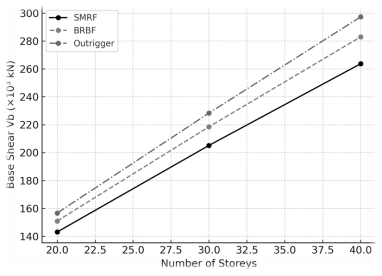
Figure 8. Base Shear vs Storeys.
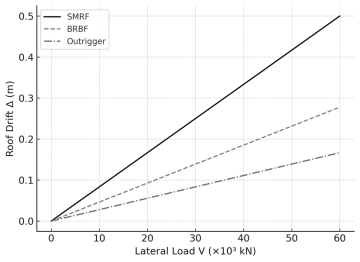
Figure 9. Roof Drift vs Storeys.

These figures show clear monotonic trends, proving the generality of the stiffness-deflection behaviour across heights.
8. Conclusions
This paper clarifies the stiffness-deflection relationship in tall steel buildings and demonstrates the consequences of flexibility under seismic and wind actions. While increased flexibility reduces seismic base shear through period elongation, it leads to significantly larger drifts and increased likelihood of wind-induced accelerations. Comparative analysis shows that:
1) Moment-resisting frames (SMRF) are drift-prone and unsuitable for mid- to high-rise buildings unless supplemented with bracing or damping systems.
2) Braced frames (BRBF) provide an effective intermediate solution, balancing stiffness and economy.
3) Outrigger-core systems offer the best overall control of drift and accelerations, making them a preferred choice for tall buildings.
Serviceability requirements from wind - rather than strength or seismic considerations - typically govern tall steel building design. The results reaffirm that optimal performance relies on achieving the correct balance of stiffness, damping, and structural system selection. Future work may incorporate soil-structure interaction and advanced damping technologies for further enhancement.
9. Novelty and Contributions
This work is distinctive in the following ways:
1) Establishes a unified framework linking stiffness, drift, and fundamental period using compact analytical relations.
2) Provides a controlled comparison of SMRF, BRBF, and outrigger-core systems under identical geometry and loading, isolating system-driven behaviour.
3) Demonstrates that wind serviceability governs tall-building drift design, a key insight for modern performance-based design.
4) Includes a worked example for Eurocode drift verification, enabling fast, practical application by designers.
5) Translates analytical findings into designer-ready guidance for stiffness targeting and system selection.
10. Key Gaps in the Study: Addresses Several Key Gaps in Conventional Serviceability Requirements
Generic deflection limits in codes:
Traditional design codes rely on simple, prescriptive limits (e.g., span/325 for beams or height/500 for drift). These limits are derived largely from low- and mid-rise construction and often fail to capture tall-building concerns such as human comfort (accelerations), dynamic wind sensitivity, or protection of non-structural elements.
1) Limited guidance on dynamic behaviour:
While codes mention wind and earthquake effects, they tend to emphasise seismic strength checks and static wind deflections. They provide little detail on predicting or controlling natural frequencies, accelerations, or dynamic amplification, which frequently govern serviceability in tall buildings.
2) Gap between codal rules and advanced analysis tools:
Modern finite element modelling, outrigger systems, mega-bracing, and other advanced structural forms are far more sophisticated than the simple span-depth or drift criteria provided in codes. Research helps bridge this gap and supports performance-based design using rational, project-specific stiffness requirements.
3) Lack of provisions for non-structural damage:
Excessive lateral drift can crack masonry partitions, damage façades, and disrupt internal finishes-even when the main structure remains safe. Research provides specific drift limits and stiffness criteria to protect non-structural components, an area insufficiently detailed in older codes.
4) Inadequate treatment of composite behaviour:
In steel-concrete composite systems, actual stiffness is reduced by effects such as concrete cracking or shear-slip at the interface. These reductions (often 10-20%) are oversimplified or ignored in many codes. Research quantifies this stiffness degradation and provides more accurate service load predictions.
Abbreviations
Δᵢ | Interstorey Drift at Level I (m) |
Δ_roof | Roof Displacement (m) |
Vᵢ | Shear at Level I (kN) |
V_b | Base Shear (kN) |
K_eff | Effective Lateral Stiffness (kN/m) |
M | Generalised Mass (kg) |
T | Fundamental Natural Period (s) |
W | Seismic Weight (kN) |
S_a | Spectral Acceleration (m/s²) |
R | Response Reduction Factor |
I | Importance Factor |
q_z | Wind Pressure at Height z (kN/m²) |
C_f | Wind Force Coefficient |
A | Area Exposed to Wind (m²) |
I | Storey Index |
Author Contributions
Vijay Kumar Khanna is the sole author. The author read and approved the final manuscript.
Conflicts of Interest
The author declares no conflicts of interest.
References
| [1] |
Abdelwahab, M., et al. (2023) Performance-based wind design for tall buildings: review and state of the art. Structures.
|
| [2] |
Angelucci, G., et al. (2025) Parametric analysis of outrigger systems for high-rise buildings. Applied Sciences, 15, 5643.
https://doi.org/10.3390/app15115643
|
| [3] |
Yang, K., et al. (2024) Effects of soil-structure interaction on RC frame-shear wall structures under long-periodground motions. Buildings, 14, 3796.
https://doi.org/10.3390/buildings14123796
|
| [4] |
Ozgan, K., Kilicer, S. and Daloglu, A. (2022) Soil-structure interaction effect on resistance of steel frame againstprogressive collapse. Journal of Performance of Constructed Facilities.
|
| [5] |
Kilicer, S., Ozgan, K. and Daloglu, A. (2018) Effects of soil-structure interaction on behavior of reinforcedconcrete structures. Journal of Structural Engineering and Applied Mechanics, 1(1), 28-33.
|
| [6] |
Kilicer, S. and Ozgan, K. (2016) Investigation of soil-structure interaction for design of reinforced concretestructures under earthquake load.
|
| [7] |
British Standards Institution (2005) Eurocode 1: Actions on structures - Part 1-4: General actions - Wind actions. BS EN 1991-1-4: 2005. London: BSI.
|
| [8] |
British Standards Institution (2004) Eurocode 8: Design of structures for earthquake resistance - Part 1: Generalrules, seismic actions and rules for buildings. BS EN 1998-1: 2004. London: BSI.
|
| [9] |
BIS: IS1893 (Part 1): 2016: Criteria for Earth Quake Resistant Design.
|
| [10] |
BIS: IS875 (Part 3): 2015: Wind Loads on Buildings and Structures.
|
Cite This Article
-
ACS Style
Khanna, V. K. Deflection-stiffness Relationship and Practical Implications for Seismic and Wind Imposed Design of Tall Steel Buildings. Am. J. Civ. Eng. 2026, 14(1), 1-10. doi: 10.11648/j.ajce.20261401.11
Copy
|
Download
AMA Style
Khanna VK. Deflection-stiffness Relationship and Practical Implications for Seismic and Wind Imposed Design of Tall Steel Buildings. Am J Civ Eng. 2026;14(1):1-10. doi: 10.11648/j.ajce.20261401.11
Copy
|
Download
-
@article{10.11648/j.ajce.20261401.11,
author = {Vijay Kumar Khanna},
title = {Deflection-stiffness Relationship and Practical Implications for Seismic and Wind Imposed Design of Tall Steel Buildings},
journal = {American Journal of Civil Engineering},
volume = {14},
number = {1},
pages = {1-10},
doi = {10.11648/j.ajce.20261401.11},
url = {https://doi.org/10.11648/j.ajce.20261401.11},
eprint = {https://article.sciencepublishinggroup.com/pdf/10.11648.j.ajce.20261401.11},
abstract = {Tall steel buildings are increasingly governed by serviceability considerations arising from seismic and wind actions, where control of lateral deflection and inter-storey drift becomes as critical as strength-based design. This paper investigates the fundamental relationship between lateral stiffness and deflection response in tall steel structures, with the objective of clarifying the role of stiffness in satisfying codal requirements for safety, serviceability, and occupant comfort. A common misconception in design practice is that increased structural flexibility invariably leads to reduced seismic demand. While period elongation associated with reduced stiffness may lower seismic base shear, it can result in excessive lateral deflections, inter-storey drifts, and wind-induced accelerations that govern serviceability performance. Using a shear-building idealisation, closed-form analytical relationships are developed to link effective lateral stiffness, fundamental natural period, inter-storey drift, and seismic base shear. Three representative lateral load-resisting systems-a steel moment-resisting frame (SMRF), a braced frame (BRBF), and a core-outrigger system-are evaluated for a 20-storey steel building to illustrate the influence of stiffness on global and local response parameters. The comparative results demonstrate that increased stiffness leads to improved drift control and wind-serviceability performance, even where seismic base shear increases modestly. A worked example is presented to demonstrate drift verification against Eurocode seismic serviceability limits and wind habitability criteria, showing that serviceability requirements often govern system selection in tall buildings. The study provides practical guidance on balancing stiffness, damping, and structural configuration during preliminary design. The proposed analytical framework supports rational comparison of alternative lateral systems and offers useful insights for engineers prior to undertaking detailed numerical analysis.},
year = {2026}
}
Copy
|
Download
-
TY - JOUR
T1 - Deflection-stiffness Relationship and Practical Implications for Seismic and Wind Imposed Design of Tall Steel Buildings
AU - Vijay Kumar Khanna
Y1 - 2026/01/16
PY - 2026
N1 - https://doi.org/10.11648/j.ajce.20261401.11
DO - 10.11648/j.ajce.20261401.11
T2 - American Journal of Civil Engineering
JF - American Journal of Civil Engineering
JO - American Journal of Civil Engineering
SP - 1
EP - 10
PB - Science Publishing Group
SN - 2330-8737
UR - https://doi.org/10.11648/j.ajce.20261401.11
AB - Tall steel buildings are increasingly governed by serviceability considerations arising from seismic and wind actions, where control of lateral deflection and inter-storey drift becomes as critical as strength-based design. This paper investigates the fundamental relationship between lateral stiffness and deflection response in tall steel structures, with the objective of clarifying the role of stiffness in satisfying codal requirements for safety, serviceability, and occupant comfort. A common misconception in design practice is that increased structural flexibility invariably leads to reduced seismic demand. While period elongation associated with reduced stiffness may lower seismic base shear, it can result in excessive lateral deflections, inter-storey drifts, and wind-induced accelerations that govern serviceability performance. Using a shear-building idealisation, closed-form analytical relationships are developed to link effective lateral stiffness, fundamental natural period, inter-storey drift, and seismic base shear. Three representative lateral load-resisting systems-a steel moment-resisting frame (SMRF), a braced frame (BRBF), and a core-outrigger system-are evaluated for a 20-storey steel building to illustrate the influence of stiffness on global and local response parameters. The comparative results demonstrate that increased stiffness leads to improved drift control and wind-serviceability performance, even where seismic base shear increases modestly. A worked example is presented to demonstrate drift verification against Eurocode seismic serviceability limits and wind habitability criteria, showing that serviceability requirements often govern system selection in tall buildings. The study provides practical guidance on balancing stiffness, damping, and structural configuration during preliminary design. The proposed analytical framework supports rational comparison of alternative lateral systems and offers useful insights for engineers prior to undertaking detailed numerical analysis.
VL - 14
IS - 1
ER -
Copy
|
Download